
Department of Quantum computing
Our Projects
Quantum Sensing
Quantum sensing leverages the principles of quantum mechanics, such as quantum coherence and entanglement, to achieve significantly enhanced measurement capabilities compared to traditional methods, enabling unprecedented levels of accuracy and precision. By exploiting the exquisite sensitivity of quantum systems to external perturbations, quantum sensors allow the detection of minute changes in measuring physical quantities with resolutions surpassing classical limits. Applications include gravitational wave detection, geophysical exploration, inertial navigation, and biomedical diagnostics, positioning quantum sensing as a transformative paradigm in metrology and high-precision instrumentation. The field is at the forefront of quantum technologies, representing a critical interface between theoretical physics and real-world applications


Quantum Photovoltaic Cells
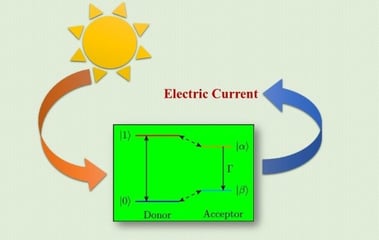
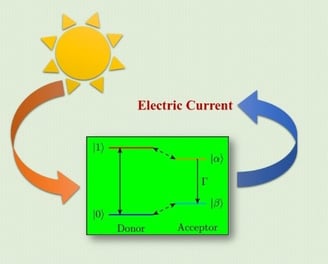
Quantum photovoltaic cells represent an emerging class of solar energy conversion devices that exploit quantum mechanical effects to overcome the fundamental efficiency limitations of classical photovoltaic technologies. These cells often incorporate engineered nanostructures, such as quantum dots and quantum wells, which enable precise control over electronic energy levels, facilitating efficient energy transfer and reducing recombination losses. Unlike traditional silicon-based solar cells, which are constrained by the Shockley-Queisser efficiency limit, the quantum photovoltaic architectures can facilitate hot-carrier extraction and minimize thermalization losses, thereby offering the potential to surpass this limit. Furthermore, their ability to absorb a broader spectrum of solar radiation and improve charge carrier dynamics positions them as a key candidate for next-generation, high-performance solar energy systems.
Quantum Battery
A quantum battery is a quantum system engineered to store and release energy using quantum phenomena like entanglement and many-body effects, enabling ultrafast charging and higher efficiency than classical batteries. In particular, collective quantum behaviors can lead to a quantum speed-up in charging times, where the charging power scales super-linearly with the number of quantum cells, a feature unattainable in classical analogs. Theoretical models typically describe quantum batteries as open quantum systems interacting with external fields or environments, where quantum thermodynamic principles govern energy transfer and work extraction. Recent progress in both theory and experimental implementation—using platforms such as spin chains, superconducting qubits, and trapped ions—suggests the feasibility of realizing compact, efficient, and fast-charging energy units at the nanoscale. These advancements position quantum batteries as promising components in future quantum technologies, particularly for powering nanoscale devices, quantum sensors, and quantum information processors.
Quantum Biology
Quantum biology is an emerging interdisciplinary field that investigates the potential role of non-classical quantum phenomena in fundamental biological processes. It explores how quantum effects may facilitate or enhance efficiency and functionality at the molecular and sub-molecular levels within living systems. Unlike traditional biochemical models, quantum biology often considers biological entities as open quantum systems, where the delicate interplay between coherent quantum states and environmental decoherence becomes central to understanding


Get in touch with us at info@qlogy.ca
© 2025. All rights reserved.